
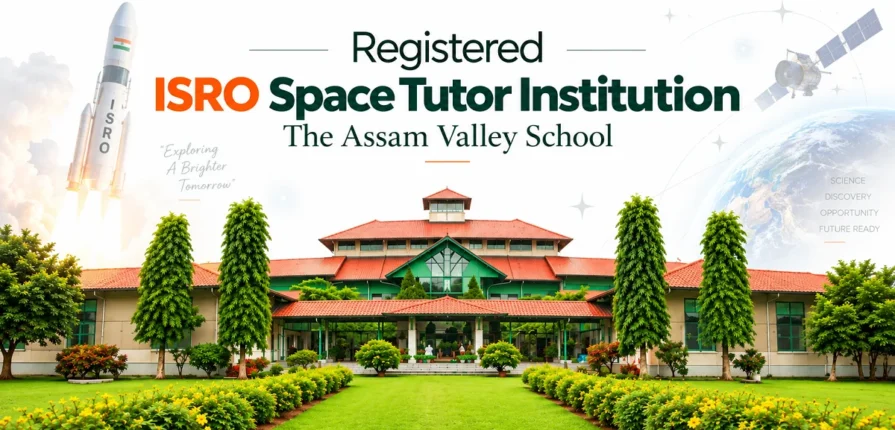
Every child has a natural tendency of liking a particular subject. But innovative and remarkable teaching methodologies can greatly influence a student’s interest. So, how do you get a child genuinely excited about complex physics equations or the mysteries of space? Most kids lose interest when teachers present science as static formulas on a whiteboard. Space exploration changes that equation overnight. When students watch rocket engines fire or track satellite paths, scientific theory suddenly connects to real machines. So, forward-thinking institutions use space concepts to make daily STEM lessons far more practical. Initiatives like ISRO’s Space Tutor initiative give schools the exact tools needed for this transition. The Assam Valley School recently earned recognition as a Registered ISRO Space Tutor Institution. This status connects students in Balipara directly to space science programmes, turning standard classrooms into active testing grounds for future engineers.
Why Space Education Matters Today
Satellite infrastructure is essential to keep today’s ground infrastructure up and running. Whenever there is the need for any local delivery application to calculate driving routes, for an agricultural team to track crop moisture levels, or for a weather station to detect impending floods, satellite infrastructure is used.
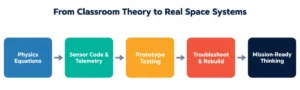
So, studying space mechanics brings physics out of abstract theory and into actual engineering work. High schoolers stop guessing answers on multiple-choice tests. Instead, they write sensor code, study real satellite telemetry, and trace mechanical errors back to faulty hardware. These exercises build sharp troubleshooting logic. Kids learn how systems fail, why they fail, and how to fix them under pressure.
How Does ISRO Space Tutor Institution Work?
The Indian Space Research Organisation (ISRO) launched the Space Tutor initiative to build strong scientific awareness across academic institutions. Through this structured framework, registered schools act as local hubs to promote space science education and STEM learning.
By participating in this program, students can access guided learning resources and STEM activities which serve as great sources of encouragement to pursue space science exploration. In contrast to simply doing regular internet surfing for information, this program helps students apply what they know in practice. The aim of this program is to engage young students to follow current space missions while building a solid foundation in basic engineering and physics principles.
Which Schools Are Registered with ISRO?
Space agency clearance governs institutional entry into the ISRO Space Tutor network through systematic background appraisal. Officers evaluate applicants against existing laboratory infrastructure, faculty competency in physical sciences, and demonstrated capacity for student-led research initiatives.
ISRO does not publish a master list of approved schools online. Instead, regional lists grow as individual schools finish the official approval process.
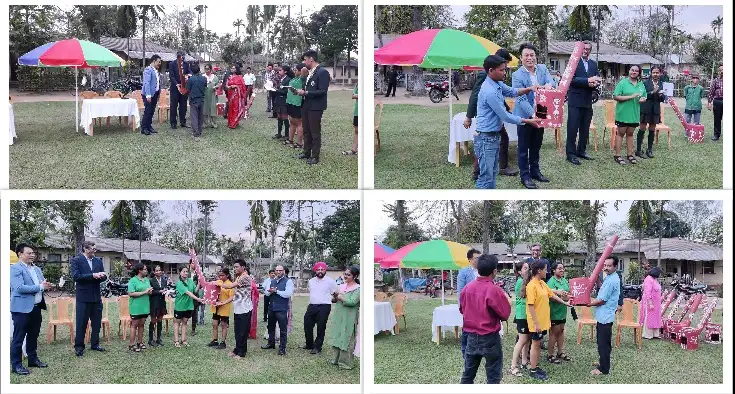
The Assam Valley School in Balipara is now officially verified on this network. This status gives our students direct access to real satellite data, specialised teaching kits, and hands-on engineering projects.
Expanding Campus Science Infrastructure
Being an ISRO-registered school in Assam is an elevation in the level of science education at The Assam Valley School. The collaboration involves the utilisation of space agency equipment, workshops, and project kits in campus laboratories.
The learners engage in more complex processes that require practical data analysis and engineering projects. With the incorporation of space technology in the curriculum of the institution, students get access to contemporary scientific tools within the campus.
Exclusive Access and National Recognition
Holding a significant place under the ISRO school partnership, The Assam Valley School joins a select national network dedicated to advancing scientific literacy. This official designation gives our students and faculty specific operational advantages:
- ISRO Certified Learning Resources: Availability of space agency learning courses, space satellite data and astronomy resources.
- Science Teacher Training Programmes: Science teacher training sessions conducted by experts in space education.
- Priority Attendance at Events: Priority access to space competitions, lectures by guest speakers and science exhibitions conducted by ISRO.
- Career Pathway in Science & Technology: The pathway that students will follow while pursuing their careers in science and technology.
How Students Benefit from Space-Based Learning
When a teacher establishes a connection between classroom topics and the cosmos, it changes how children understand it— certainly in a positive way. Here is how space-focused activities impact student growth across four main areas:
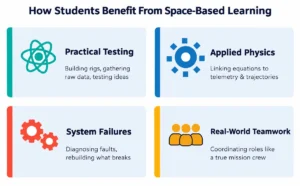
Practical Testing
Kids drift away from passive memorisation and start focusing on concepts. They question how physical equipment breaks, assemble rough test rigs, and hunt down raw data to prove what works.
Applied Physics
Physics formulas stop being abstract when students use them to build physical projects instead of solving numbers on a page just to pass a test. Kids use simple calculations to check if a model rocket can handle heat or if a circuit board will stay powered during a test launch. The math suddenly makes sense because it serves a clear purpose.
System Failures
Space projects force students into real troubleshooting. When a prototype fails mid-run, kids trace hardware faults, rewrite code, and rebuild the model until it holds up.
Real-World Teamwork
Space missions demand good coordination; they cannot be carried out individually. Children can be taught to distribute their roles, articulate their ideas, and rely on other members of their teams who have been assigned certain tasks such as monitoring launches and checking the equipment.
The Assam Valley School’s Journey Towards Future-Ready Learning
For this generation to be future ready, they require an education system which is grounded on the theories of experiential learning and scientific research. The Assam Valley School has always been devoted to creating people who have the confidence to explore the world of technology.
This recognition strengthens the school’s long-standing commitment to experiential learning and scientific inquiry. As an ISRO-registered space tutor and one of the recognised institutions promoting ISRO space education in Indian schools, The Assam Valley School science programmes give students opportunities to connect classroom concepts with real-world scientific exploration. As a boarding school that actively promotes STEM and space education, this milestone reflects an ongoing focus on building genuine scientific curiosity across both lower and upper school classrooms.
Preparing Students for Tomorrow’s Challenges
In the future, industries shall continue developing as a result of artificial intelligence, satellite technology, weather models, robotics, and advanced system architecture. The students of today shall find themselves working in technical careers that do not even exist yet.
Introducing the lessons of space science into everyday school programmes will teach the children to think flexibly. When the time comes for them to consider how the engineers deal with delay problems when communicating in space and create devices that can function under harsh temperature conditions, they will be taught to think like that. This way of thinking will benefit them whatever career they may pursue.
Conclusion
Space education teaches students to look beyond what they know, question what they see, and imagine what is possible. As the best boarding school with ISRO recognition, The Assam Valley School continues to strengthen its space education initiatives while inspiring students to develop scientific curiosity, critical thinking, and confidence that extend far beyond the classroom. By encouraging students to question, explore, and experiment from an early age, schools help shape the scientists, innovators, and responsible leaders who will solve tomorrow’s challenges.
Frequently Asked Questions
Q1. What is the ISRO Space Tutor Programme?It is an official educational initiative supported directly by India’s national space agency to enhance our science curriculum. Through this partnership, our school receives certified learning modules, practical kit designs, and structured project frameworks. Instead of covering space science purely through textbook readings, our teachers use these resources to lead hands-on activities using verified scientific data. |
Q2: Which schools are registered with the ISRO Space Tutor Programme in India?ISRO maintains a selective network of accredited educational institutions designated as official Space Tutors across the country. The Assam Valley School in Balipara is a registered ISRO Space Tutor Institution, granting its students direct access to official space agency course modules, satellite data sets, and structured STEM project frameworks designed by space science experts. |
Q3. Do students need advanced math skills to participate in these activities?Not at all. We integrate these activities across multiple grade levels, tailoring the complexity to match standard classroom learning. Younger students begin with foundational concepts like basic astronomy, simple model construction, and team data collection. As students advance in their regular maths and science classes, they gradually progress to detailed calculations like plotting orbital paths and analysing propulsion physics. |
Q4. Is the programme suitable for kids who do not want to become astronauts?Yes, the skills taught apply to virtually every modern industry. Space missions require massive multidisciplinary teams, including software developers, data analysts, environmental researchers, weather forecasters, and project coordinators. Our primary goal is not just training future aerospace engineers but developing critical thinking, clear technical communication, and structured logic that give students an edge in any career path they choose. |
Q5. How can parents support space science education at home?The best way parents can support this learning is by encouraging thoughtful investigation over quick answers. When a home experiment or building project does not work on the first try, help your child examine why the structure failed rather than treating it as a setback. Simply asking open-ended questions about how things work and staying curious about current scientific events helps reinforce what they learn in our labs. |





 WhatsApp
 Student Login
 Register Now